
Understanding SQL Server Execution Plan Operators and Their Impact on Performance
Optimizing query performance in SQL Server requires understanding execution plans. Here’s a look at common operators that can impact performance, ranked by their frequency and impact, with examples using the opensource StackOverflow database.
1. Table Scans
- Commonality: Very High
- Impact: High
- Description: Occurs when SQL Server reads every row in a table, often due to lack of indexes.
- Example:
- Note: Results in a table scan if no index on Reputation.

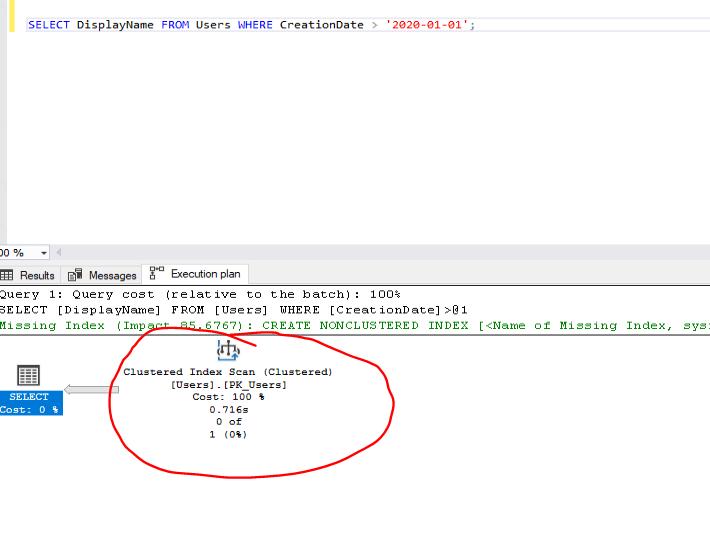
2. Index Scans
- Commonality: High
- Impact: Moderate to High
- Description: Reads every row in an index; less efficient if the index is not selective.
- Example:
- Note: Might result if there is no index CreationDate.
3. Key Lookups
- Commonality: High
- Impact: Moderate to High
- Description: Occurs when a non-covering index requires additional lookups to fetch complete rows.
- Example:
- Note: Results in key lookups if the index on Location does not include DisplayName .

4. Nested Loops
- Commonality: Moderate
- Impact: Variable
- Description: Efficient for small datasets; can be inefficient with larger datasets or costly inner table scans.
- Example: SELECT p.Title, u.DisplayName FROM Posts p INNER JOIN Users u ON p.OwnerUserId = u.Id WHERE u.Reputation > 10000;
- Note: Might use nested loops if the Users table is large and lacks a suitable index.

5. Sort Operations
- Commonality: Moderate
- Impact: High
- Description: Required by ORDER BY clauses, certain joins, or DISTINCT operations.
- Example:
- Note: Requires sorting the Users table by Reputation.

6. Hash Joins
- Commonality: Moderate
- Impact: High
- Description: Uses a hash table to join rows from two tables, typically when no suitable indexes exist.
- Example: SELECT p.Title, u.DisplayName FROM Posts p INNER JOIN Users u ON p.OwnerUserId = u.Id WHERE p.CreationDate > ‘2020-01-01’ AND p.Score > 0 AND u.Reputation > 1000;
- Note: Might use a hash join if there are no suitable indexes. (Had to force a Hash Join since the optimizer didn’t want to play ball)

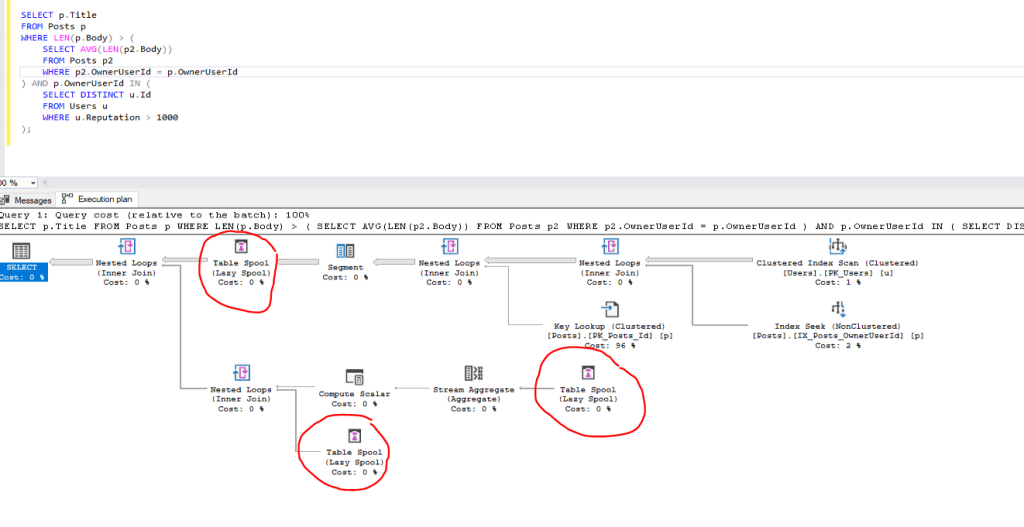
7. Spools
- Commonality: Moderate
- Impact: Moderate to High
- Description: Temporarily stores intermediate results to optimize certain queries.
- Example:
SELECT p.Title FROM Posts p WHERE LEN(p.Body) > (SELECT AVG(LEN(p2.Body)) FROM Posts p2 WHERE p2.OwnerUserId = p.OwnerUserId) AND p.OwnerUserId IN (SELECT DISTINCT u.Id FROM Users u WHERE u.Reputation > 1000);- Note: Complex queries with subqueries and joins might cause a spool operation.
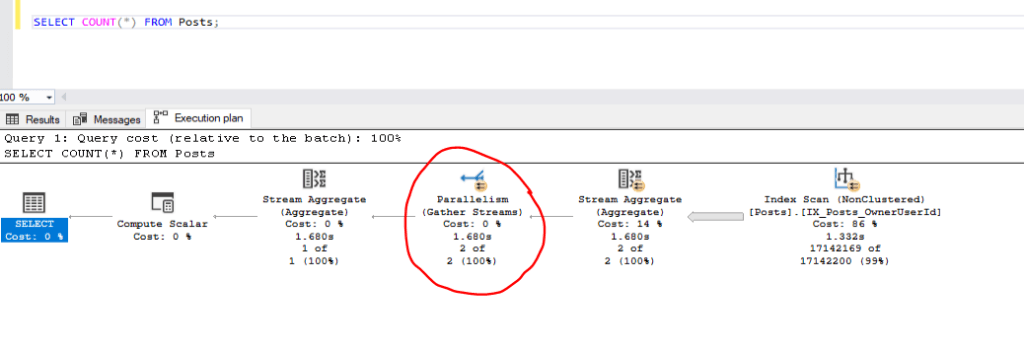
8. Parallelism
- Commonality: Variable
- Impact: High
- Description: Distributes query processing across multiple CPU cores.
- Example:
- Note: SQL Server might use parallelism to speed up the count operation for large tables.
Summary
- Most Common: Table Scans, Index Scans, Key Lookups
- Most Impactful: Table Scans, Sort Operations, Hash Joins, Parallelism
 MosherData
Leave a comment