

SARGability (Search ARGument ABLE) is an important concept in SQL Server performance tuning because it allows the database engine to use indexes to quickly retrieve data. When a query is SARGable, it can leverage indexes on the columns, especially in the WHERE clause, enabling SQL Server to directly access the relevant data instead of performing a slower full table scan.
How to Ensure SARGable Queries
Avoid Functions on Columns
Non-SARGable:
SELECT * FROM Users WHERE SUBSTRING(DisplayName, 1, 1) = ‘A’;
This query applies the SUBSTRING function to the DisplayName column, making it non-SARGable.
SARGable:
SELECT * FROM Users WHERE DisplayName LIKE ‘A%’;
This query uses a pattern match that can utilize indexes on the DisplayName column.
Use Equality Comparisons
Non-SARGable:
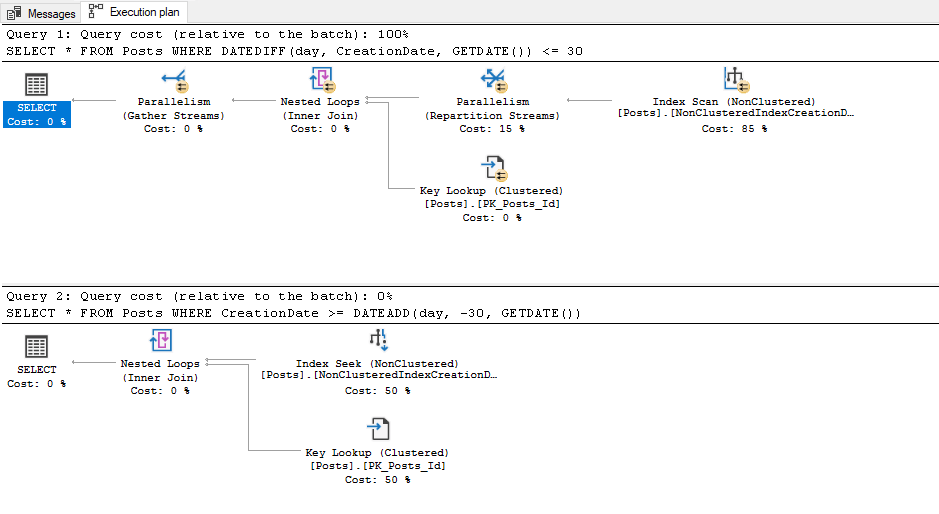
SELECT * FROM Posts WHERE DATEDIFF(day, CreationDate, GETDATE()) <= 30;
The DATEDIFF function on CreationDate prevents the use of indexes.
SARGable:
SELECT * FROM Posts WHERE CreationDate >= DATEADD(day, -30, GETDATE());
This query uses a direct comparison that allows SQL Server to use indexes on the CreationDate column.
Avoid Negative Conditions
Non-SARGable:
SELECT * FROM Comments WHERE NOT (Score = 0);
The NOT condition makes the query non-SARGable.
SARGable:
SELECT * FROM Comments WHERE Score <> 0;
Using <> instead of NOT can make the query SARGable, allowing the use of indexes on the Score column.
Using OR in WHERE Clauses
Non-SARGable:
SELECT * FROM Users WHERE Location = ‘Canada’ OR Location = ‘United States’;
The OR condition can lead to full table scans.
SARGable (using UNION ALL):
SELECT * FROM Users WHERE Location = ‘Canada’
UNION ALL
SELECT * FROM Users WHERE Location = ‘United States’;
This query uses UNION ALL to split the conditions into separate queries that can each use indexes.
Additional Tips for SARGable Queries
- Use indexed columns in your WHERE clause whenever possible (or index your columns in your WHERE clause).
- Avoid complex expressions and functions on columns in the WHERE clause.
- Consider the data types of the columns and the values being compared to ensure they match.
- Rewrite queries to use range conditions (>=, <=, BETWEEN) instead of functions or non-SARGable expressions.
By writing SARGable queries, you allow SQL Server to use indexes effectively, which can result in faster query execution and reduced resource usage.
 MosherData
Leave a comment